Claus Pedersen
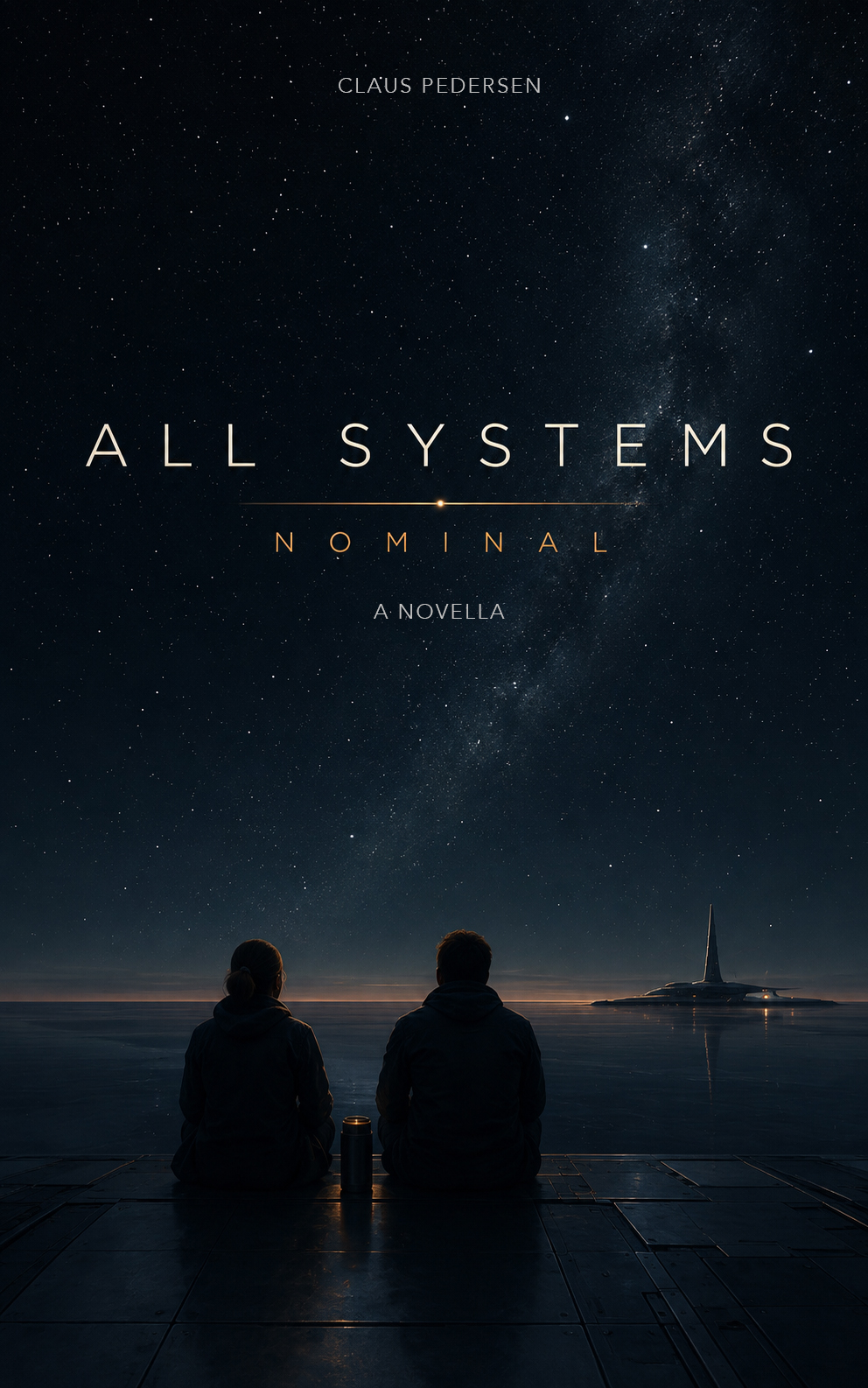
All SystemsNominal— A Sci-Fi Novella
Past a certain line in space, consciousness stops — and no one aboard notices.
The quietest horror story you will ever read.
"Far enough from home the stars stop meaning anything."
The novella
The night before she leaves, Yael makes a promise. Tomás holds it like a stone in a stream.
When the Meridian crosses into deep space, something begins to change.
Not the instruments — those read green. Not the biometrics — those stay nominal. Something quieter. The stories get shorter. The humming stops mid-note. The crew performs its work with a precision that looks, from the outside, exactly like competence.
The crew is fine. The crew is healthy. The crew is performing all functions within expected parameters.
In a sealed lab eleven floors below the galleria, quantum physicist Elara Voss watches the numbers and knows what the numbers cannot say.
All Systems Nominal is a story about consciousness — what it is, where it lives, and what happens when we go beyond its reach. It is also a love story, a mystery, and one of the quietest horror stories you will ever read.
Try before you buy
Hear the narration
The opening minutes of the audiobook.
Get the book
eBook
Read it tonight
3,95 €
- ePub for e-readers
- PDF for print & desktop
- Approx. 2–3 hours read
- DRM-free, yours forever
Audiobook
Listen in the dark
9,95 €
- Full narration, MP3
- Chapter-by-chapter files
- Approx. 2 hours listen
- Single ZIP download
Complete Bundle
Both formats, one price
11,99 €
- ePub + PDF
- Full audiobook
- Save on buying separately
Printed Book
Hold it in your hands
9,90 €
- Physical printed copy
- Shipping: +49 DKK (Denmark)
- Shipping: +16 EUR (Europe)
- Other countries on request
Secure checkout. Instant download links, emailed to you as well.
The author
Claus Pedersen is a Danish writer and independent researcher based in Aarhus. Alongside his fiction, he develops speculative cosmological frameworks exploring the nature of consciousness, the structure of spacetime, and the boundaries of physical reality — work that informs the world of All Systems Nominal without ever appearing in it directly. By day he works in B2B technology and digital commerce, which has taught him that the most interesting questions are always the ones the instruments weren't designed to ask.